
Where to Sell Pokémon Cards: 8 Options Compared (Online and Local)
PullBull TeamUpdated 10 min read
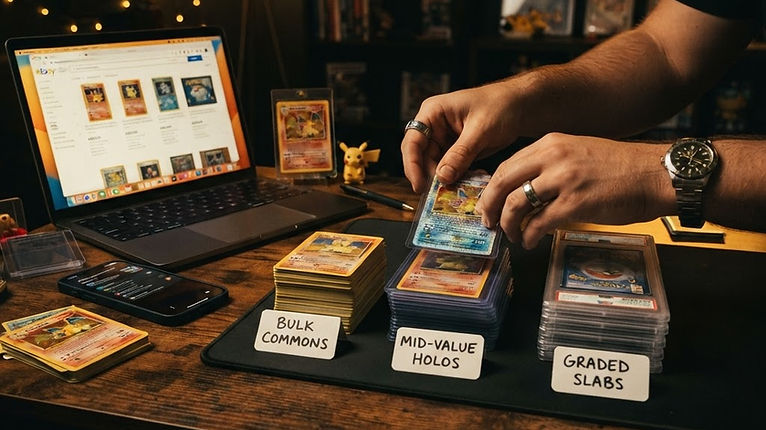
Where to Sell Pokémon Cards: 8 Options Compared (Online and Local)
You have a binder, a shoebox or a few slabs, and you want to turn some of them into money. The hard part is not finding a place to sell Pokémon cards. It is picking the right place for each card, because a bulk common, a $40 alt art and a graded vintage holo usually sell best in very different places.
If you would rather let buyers set the price than fix one yourself, Pokémon Card Auction Sites Compared covers the auction route end to end.
This guide walks through the main options, what each one is good at, and a simple way to decide where every card in your pile should go.
Most sellers get the best results by splitting their cards first. A rough sort is enough:
Then check what each single and high-value card actually sells for. Use recent sold prices, not asking prices. Our guide on how much your Pokémon cards are worth shows how to do this quickly. Knowing the value first protects you from accepting a low offer and helps you pick the right selling option.
General marketplaces are where most people start. You create a listing with photos and a description, and buyers find it by searching for the card name.
Good for: singles and graded cards, especially popular cards that people search for by name.
Watch out for: selling fees and payment processing, competition from many similar listings, and the time it takes to photograph and list each card.
If you want to compare the main sites, our list of sites like eBay for trading cards covers the bigger options and how they differ.
Some marketplaces are built only for trading card singles. Buyers search by set and card number, pick a condition and buy at a fixed price. Prices are often very competitive, because many sellers list the same card.
Good for: modern singles in common conditions, and sellers who want to list a lot of cards in a structured way.
Watch out for: a race to the lowest price on popular cards, strict condition rules and seller requirements that vary by country. Check each platform's seller rules and fee page before you sign up.
On live shopping apps, sellers stream on camera and run fast auctions while viewers bid in real time. Pack openings and breaks are a big part of the scene.
Good for: sellers who enjoy being on camera and want to move many mid-value cards in one session.
Watch out for: quiet streams where cards end below value, and the time it takes to build a regular audience. We compare live selling and listings in detail in Whatnot vs eBay for selling cards.
Timed online auctions let buyers compete for a card over hours or days. At the top end, specialist auction houses handle high-value graded cards and rare vintage.
Good for: cards with several interested buyers, rare cards that are hard to price, and high-value slabs.
Watch out for: buyer's premiums that change what bidders are willing to pay, minimum values at some auction houses, and auctions that end low when few people are watching. Our comparison of Pokémon card auction sites and our guide to how online card auctions work explain opening bids, reserves and buyer's premiums.
Many game and hobby stores buy Pokémon cards for cash or store credit. You walk in, they look at your cards and make an offer on the spot.
Good for: speed, convenience and getting rid of bulk. Store credit offers are often higher than cash offers, which is useful if you play or buy sealed product.
Watch out for: offers below market value. A shop needs to resell your cards and make a profit, so expect less than you would get selling directly to a collector. That is the price of a fast, simple sale.
Some stores and websites publish a buylist: a list of cards they will buy and the price they will pay for each condition. You ship the cards, they check them and pay you.
Good for: selling many singles at once without listing each card, and for bulk sold by count.
Watch out for: condition checks on arrival that can lower the payout, and shipping costs and risk on your side. Pack the cards properly and use tracking. Our guide to how to ship trading cards safely shows how.
Card shows bring many dealers and collectors into one room. You can sell to dealers, trade, or show cards to collectors directly.
Good for: mid-value and high-value cards, getting several offers in one day, and meeting serious collectors.
Watch out for: dealer offers below market price, the cost of getting there, and the need to know your prices before you start talking. Bring a list of recent sold prices on your phone.
Facebook groups, Discord servers, Reddit trading communities and local meetups all have buy, sell and trade threads. Selling directly to another collector can mean a better price for you and a fair price for them.
Good for: cards that a specific community wants, trades and building a local reputation.
Watch out for: scams. Read each group's rules, check the buyer's history and references, use a payment method with protection where one is available, and never ship before you are confident the deal is real. Many groups also have strict formats for sale posts.
| Option | Speed | Price you usually get | Effort | Best for |
|---|---|---|---|---|
| Big online marketplaces | Medium | Close to market | Medium to high | Singles, graded cards |
| Singles marketplaces | Medium | Close to market, competitive | Medium | Modern singles |
| Live selling apps | Fast once you have an audience | Varies by stream | High | Many mid-value cards |
| Auction sites and houses | Days to weeks | Market or above with strong demand | Medium | Rare and high-value cards |
| Local card shops | Same day | Below market | Low | Bulk, quick cash or credit |
| Buylists | One to a few weeks | Below market | Low to medium | Many singles, bulk |
| Card shows | One day | Below market to close to market | Medium | Mid and high-value cards |
| Collector groups | Varies | Close to market | Medium | Community favorites, trades |
These are general patterns, not guarantees. Fees, payouts and rules change, so check the current terms for any platform or buyer before you sell.
If you like the idea of auctions but do not want to stream, PullBull is a card-focused marketplace built around collector stores and timed auctions. Sellers get their own store, and each auction shows its opening bid, bid history and a bid trend chart. Buyers can watch cards, follow stores and filter by condition and by graded or raw.
PullBull is in an early, pre-launch stage, so the number of listings is still small. Paid checkout and payment protection are not active yet. Buyers and sellers use the contact seller button to agree on packing, tracking and who pays postage before going ahead. Learn more in what is PullBull?
Want to see how timed card auctions look? Explore collector stores and current auctions. Browse auctions on PullBull
Where is the best place to sell Pokémon cards? There is no single best place. Online marketplaces and auctions usually get closer to market value for singles and graded cards, while local card shops and buylists are faster but pay less. Many sellers use different options for different cards.
Where can I sell Pokémon cards near me? Look for local game and hobby stores, card shows and local collector meetups or groups. Call ahead to ask whether a shop is buying Pokémon cards and whether it offers cash or store credit.
Is it better to sell Pokémon cards online or to a shop? Online selling usually gets a higher price because you sell directly to collectors, but it takes more time and you handle shipping. A shop is faster and simpler but pays less, because it needs to resell the cards for a profit.
How do I sell bulk Pokémon cards? Bulk usually sells by count to local shops, to buylists that accept bulk, or as lots online. Sort out any holos, rares and full arts first, since those are often worth selling separately.
Should I grade my Pokémon cards before selling? Only when the expected price difference between raw and graded is clearly bigger than the grading cost, shipping and waiting time. Check recent sold prices for raw and graded copies of the same card before you decide.
How do I avoid scams when selling Pokémon cards? Use platforms and payment methods with clear rules, check buyer history in groups, never accept requests to move a deal off-platform in a way you do not trust, and ship with tracking. Keep photos of the card and the packed order before you ship.
The right place to sell Pokémon cards depends on the card. Sort your collection into bulk, singles and high-value cards, check recent sold prices, then match each pile to the option that fits: shops and buylists for speed, marketplaces and collector groups for singles, and auctions for cards with real demand. And if you want to try timed auctions on a site built only for cards, browse auctions on PullBull.
Related: How much are my Pokémon cards worth? · Sites like eBay for trading cards · Pokémon card auction sites compared · Whatnot vs eBay for selling cards · How to ship trading cards safely
Browse live auctions and listings on PullBull.
Browse Pokémon card auctions on PullBull