
Whatnot vs eBay for Selling Cards: Which Is Better for Your Collection?
PullBull TeamUpdated 9 min read
Whatnot vs eBay for Selling Cards: Which Is Better for Your Collection?
If you want to sell trading cards online, two names come up again and again: Whatnot and eBay. Both have huge card communities, and both can sell a Pokémon card, a sports rookie or a sealed pack. But they work in very different ways, and the better choice depends on how you like to sell, how much time you have and what kind of cards you own.
If neither platform suits your cards, Sites Like eBay for Trading Cards compares the wider field of alternatives.
This guide compares Whatnot and eBay in plain terms, so you can pick the right one for each card, or use both.
The rest of this article explains why.
Whatnot: live selling
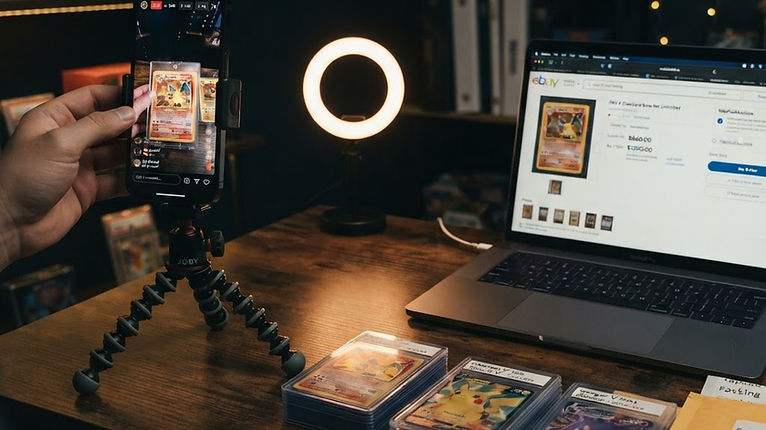
Whatnot is a live shopping app. Sellers start a stream, show cards on camera and run short auctions while viewers bid in real time. Many card streams also include pack openings and breaks. A good stream feels like a small show, with chat, giveaways and regular buyers who come back each week.
Whatnot also lets sellers list items outside of a live show, but the heart of the platform is the live stream. Most sales happen while you are on camera.
eBay: listings and search
eBay is a general marketplace where you create a listing with photos, a title and a description. You can choose a timed auction, a fixed price (Buy It Now), or fixed price with an option for buyers to send offers. Buyers find your card by searching, filtering and browsing, often days or weeks after you list it.
eBay also has card-specific tools that change over time, such as authentication programs for certain cards and a vault service for storing high-value cards. Check eBay's current help pages for what is available in your country.
| Factor | Whatnot | eBay |
|---|---|---|
| Selling style | Live streams with fast auctions | Listings: auction, fixed price or offers |
| Time commitment | You need to be live and on camera | List once, then manage questions and sales |
| How buyers find you | Followers, stream discovery, categories | Search, filters and saved searches |
| Best for | Bulk, mid-value cards, packs, breaks | Single cards, graded cards, rare items |
| Price control | Auctions can end low on a quiet stream | Fixed price or a reserve on auctions |
| Audience | Very active card community, often younger | Very large general audience worldwide |
| Getting started | Seller approval may be required | Open to most sellers, with some limits for new accounts |
Platform rules and features change, so treat this table as a starting point and confirm details on each platform before you sell.
Both platforms take a share of each sale, and both charge payment processing. The exact rates depend on the category, your country, your seller level and any current promotions, and they change from time to time. Instead of trusting a number from an old forum post, check each platform's official fee page on the day you list.
When you compare, add up the full cost of a sale, not just the headline percentage:
A simple way to compare is to take one real card you plan to sell, estimate what it would sell for on each platform, then subtract every cost above. The platform that leaves you more money for that card wins, and the answer can change from card to card.
| Card type | Often a better fit |
|---|---|
| Bulk commons and low-value cards | Whatnot streams, or sold as lots on either platform |
| Mid-value singles | Either; Whatnot for speed, eBay for price control |
| High-value graded cards | eBay listings, or a specialist auction site |
| Sealed packs and boxes | Whatnot streams and breaks, or eBay listings |
| Rare or niche cards with few buyers | eBay, where the right buyer can find them by search |
For high-value cards, also look at auction houses and other marketplaces. Our comparison of Pokémon card auction sites and our guide to sites like eBay for trading cards cover more options.
Some collectors like auctions but do not want to stream, and want something built only for cards rather than a general marketplace. That is the idea behind PullBull. Sellers get their own store and list cards as timed auctions, so there is no need to go live. Each auction shows its opening bid, bid history and a bid trend chart, and buyers can watch cards, follow stores and filter by condition and by graded or raw.
PullBull is in an early, pre-launch stage, so the number of listings is still small. Paid checkout and payment protection are not active yet. Buyers and sellers use the contact seller button to agree on packing, tracking and who pays postage before going ahead. Learn more in what is PullBull?
Prefer timed card auctions over live streams? Explore collector stores and current auctions. Browse auctions on PullBull
Is Whatnot or eBay better for selling Pokémon cards? It depends on how you sell. Whatnot suits sellers who enjoy live streaming and want to move many cards quickly. eBay suits sellers who want to list cards once and let buyers find them by search. Many sellers use both.
Do cards sell for more on Whatnot or eBay? There is no fixed answer. A busy Whatnot stream can push prices up, but a quiet one can end low. eBay fixed price listings give you more control but may sell more slowly. Compare recent sold prices for your specific card.
Which has lower fees, Whatnot or eBay? Fees change and depend on the category, your country and your seller account. Check both platforms' official fee pages, then compare the full cost of a sale, including payment processing, shipping and your time.
Do I need to go live to sell on Whatnot? Live streams are the core of Whatnot and where most sales happen. Whatnot also offers ways to list items outside a stream, so check its current seller options.
Is eBay good for graded cards? Yes. Many buyers search eBay for specific graded cards, and eBay sold listings are a common price reference. For very high-value slabs, also compare specialist auction houses.
Can I sell cards without streaming or using a general marketplace? Yes. Card-focused marketplaces, collector communities, local shops and card shows are all options. PullBull offers timed card auctions without streaming; it is pre-launch, and paid checkout and payment protection are not active yet.
Whatnot and eBay are both strong places to sell trading cards, but they reward different sellers. Whatnot rewards energy, consistency and volume. eBay rewards good listings, fair prices and patience. Look at the cards you have, the time you can give and how much price control you want, then pick the platform that fits each card. And if you prefer timed auctions on a site built only for cards, browse auctions on PullBull.
Related: Sites like eBay for trading cards · Pokémon card auction sites compared · How online card auctions work · How much are my Pokémon cards worth? · How to ship trading cards safely
Browse live auctions and listings on PullBull.
Browse Pokémon card auctions on PullBull