
Is It Worth Grading Pokémon Cards? How to Decide Before You Submit
PullBull TeamUpdated 9 min read
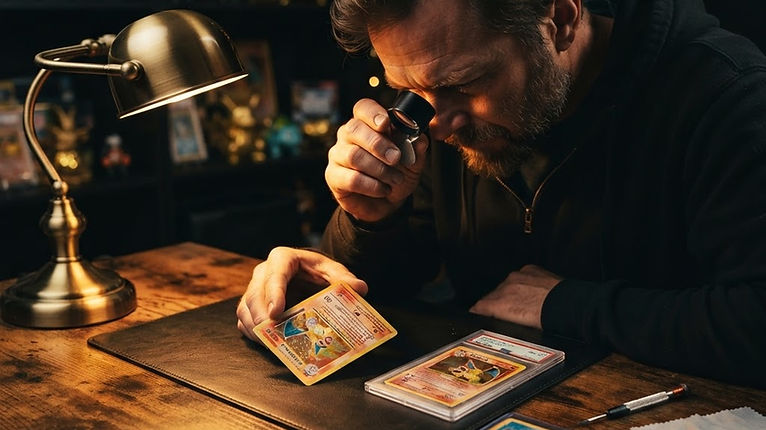
Is It Worth Grading Pokémon Cards? How to Decide Before You Submit
Grading can turn a Pokémon card into a sealed, verified slab that buyers trust and often pay more for. It can also cost you money, months of waiting and a grade lower than you hoped. Whether it is worth it depends on the card, its condition and what you plan to do with it.
This guide gives you a simple way to decide, card by card, before you pay a single submission fee.
Grading is usually worth it when three things are true:
If any of these is missing, you are often better off keeping the card raw or selling it raw. Most cards in a typical collection fall into that group, and that is normal.
A grading company such as PSA, CGC, Beckett (BGS) or SGC inspects your card, checks that it is genuine, gives it a grade, usually on a 1 to 10 scale, and seals it in a tamper-evident plastic case called a slab with a label and certification number.
That gives buyers three things a raw card cannot:
For a full breakdown of the companies and grade scales, read our trading card condition and grading guide.
Before anything else, look up recent sold prices, not asking prices, for three versions of your card:
That third number matters most. Many collectors only look at the top-grade price and assume they will get it. In reality, plenty of cards that look perfect come back a grade or two lower. If a 9 sells for roughly the same as a raw copy, grading only pays off if you hit the 10.
Our guide on how much your Pokémon cards are worth shows how to find reliable sold prices and avoid misleading listings.
Graders look at four areas. Check each one under good light, ideally with a magnifier or your phone camera zoomed in.
Be strict with yourself. If you can find a flaw without trying hard, a professional grader will find it too. A useful habit is to photograph the card the way a buyer would see it. Our guide to photographing trading cards explains how to light a card so flaws are easy to spot.
The submission fee is only part of the cost. Before you submit, add up:
Fees and turnaround times change often, so always check each grading company's current pricing page before you decide. Then compare the total cost per card with the price gap you found in Step 1.
Here is a simple way to think about it, without needing exact figures:
If the value at your realistic grade minus the total grading cost is not clearly higher than the raw value, grading is a gamble rather than an investment. Some collectors still take that gamble on a favorite card, and that is a fine choice, as long as you know that is what you are doing.
Each major company has its own reputation, grade scale, label style and pricing. PSA is widely recognized among Pokémon collectors. CGC is popular for modern cards. BGS is known for subgrades on centering, corners, edges and surface. SGC is respected and often chosen for its clean look and turnaround. Newer graders have also entered the market.
For selling, a practical rule is to look at which company's slabs sell best for your specific card. Search sold listings for the same card and grade from different companies and compare. For a side-by-side look at each company's basics, see our condition and grading guide.
If you decide to sell, both raw and graded cards can do well. Raw cards need clear photos, an honest condition description and careful packing. Graded cards are easier to describe, since the label does much of the work, but they still need safe packaging. Our guide on how to ship trading cards safely covers both.
Auctions can work well for in-demand graded cards because several interested buyers compete on price. If you are new to the format, read how online card auctions work.
PullBull is a marketplace built only for collectible trading cards. Sellers get their own stores and list cards as timed auctions, and buyers can filter listings by condition and by graded or raw. Each auction shows its opening bid, bid history and a bid trend chart.
PullBull is in an early, pre-launch stage, so the number of listings is still small. Paid checkout and payment protection are not active yet. Buyers and sellers use the contact seller button to agree on packing, tracking and who pays postage before going ahead. Learn more in what is PullBull?
Have raw or graded Pokémon cards to buy or sell? Explore collector stores and timed card auctions. Browse auctions on PullBull
Is it worth grading Pokémon cards for profit? Only for some cards. Grading tends to pay off for in-demand cards in excellent condition, where the graded value at a realistic grade is clearly higher than the raw value plus all grading costs. For most common cards, it does not.
What grade does a card need to be worth grading? It depends on the card. For many modern cards, only the top grade sells for much more than raw. For vintage and scarce cards, even mid grades can be valuable. Check sold prices at several grades before you decide.
How can I tell if my card will get a 10? You cannot know for sure, but you can improve your odds. Check centering, corners, edges and surface under strong light with magnification. Any flaw you can see easily will likely lower the grade.
Should I grade cards straight from a pack? Fresh pulls can be in great condition, but factory flaws such as off-center cuts, print lines and edge roughness are common. Inspect every card before submitting, even if it has never been played.
Does grading protect a card from being fake? Grading companies authenticate cards before grading them, which is a big reason buyers trust slabs. Fake slabs also exist, so buyers should check the certification number on the grading company's website.
Can I sell graded and raw cards on PullBull? Yes. Sellers can list both, and buyers can filter by graded or raw. Paid checkout and payment protection are not active yet, so buyers and sellers arrange packing, tracking and postage through the contact seller button.
Grading Pokémon cards is worth it when the card is in demand, the condition is excellent and the math still works at a realistic grade. Look up sold prices at several grades, inspect your card honestly, add up the full cost and compare. Grade the cards that pass, and sell or keep the rest raw with confidence. When you are ready to buy or sell, browse auctions on PullBull.
Related: Trading card condition and grading guide · How much are my Pokémon cards worth? · How to spot fake Pokémon cards · How to photograph trading cards · How to ship trading cards safely · Pokémon card auction sites compared
Browse live auctions and listings on PullBull.
Browse auctions on PullBull
Learn how to spot fake Pokémon cards with simple checks for text, color, holo, card stock, set symbols and graded slabs, plus red flags when buying online.

Learn card condition grades from Near Mint to Damaged, raw vs graded, and how PSA, BGS, CGC and SGC differ for Pokémon, sports, MTG and One Piece.

