
How to Spot a Fake PSA Slab: Checking Graded Pokémon Cards Before You Buy
PullBull TeamUpdated 9 min read
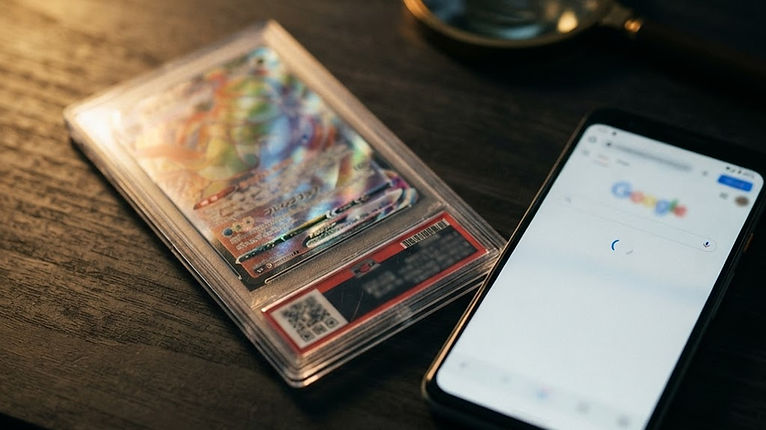
How to Spot a Fake PSA Slab: Checking Graded Pokémon Cards Before You Buy
A graded card feels like the safe way to buy. Someone else has already checked the card, given it a grade and sealed it in a hard plastic case. That trust is exactly why counterfeiters copy slabs. A fake slab can hold a fake card, or a real card that is worth far less than the label says.
The good news is that most fake slabs fail simple checks you can do from your phone or desk. This guide walks you through them, step by step, so you can check a graded Pokémon card before you bid or pay.
PSA is the name most people search for, so we use it in the examples. The same method works for CGC, BGS and other graders. If you are still learning how the big graders differ, start with our comparison of PSA vs CGC vs BGS for Pokémon cards.
Before you buy any graded Pokémon card:
No single check proves a slab is real. Several checks that all agree give you real confidence.
It helps to know what you are looking for. Problem slabs usually fall into a few groups:
Each check below targets one or more of these.
Every major grader prints a unique certification number on the label. Each one also offers a free lookup on its official website where you type in that number.
A result that exists is only the start. A counterfeiter can copy a real number from another slab, so the next step matters just as much.
Compare the lookup result with the label and the card, line by line:
Some graders also show images of the card for many certs. If images are available, compare them closely with the seller's photos. Look at small things a forger cannot copy: a tiny print line, the exact centering, a speck on the border. Two different copies of the same card are never identical.
If the lookup describes a different card, a different grade, or the images do not match, do not buy.
Fake labels are often close, but not perfect. Put the seller's photo next to a slab you own, or next to photos from the grader's own site of the same label style.
Look at:
Small differences can come from lighting or the camera. If you are unsure, ask for another photo in daylight, straight on, with no filter.
The plastic case tells its own story. Genuine slabs are sealed at the factory, and opening one usually leaves marks.
Check for:
Ask the seller for photos of the slab from the side and at an angle, not only straight on. Tampering is often easiest to see at the edges.
A real label on a swapped card is still a bad deal. Check the card through the plastic just like you would a raw card:
For a full checklist on fake cards themselves, read how to spot fake Pokémon cards.
Many fake slabs can be spotted before you even look at the card:
None of these alone proves a fake, but each one is a reason to slow down.
A good seller expects questions on a graded card. Ask politely and clearly:
If a seller cannot or will not provide these, it is fine to walk away. There will always be another copy.
PullBull is a collector-focused marketplace built around timed auctions and seller stores, with filters for graded and raw cards. PullBull is in an early, pre-launch stage, so listings are still limited. Paid checkout and payment protection are not active yet. Use the contact seller button to ask for label, case and cert photos before you bid, and check the cert number yourself on the grader's website. Learn more in what is PullBull?
Ready to look at graded Pokémon cards? Browse Pokémon card auctions on PullBull
How do I check if a PSA slab is real? Type the cert number from the label into the lookup on PSA's official website. Then check that the card name, set, number, variant and grade all match the slab and the card inside.
Can a fake slab have a real cert number? Yes. Counterfeiters sometimes copy a number from a genuine slab. That is why you should match every detail and compare any images the grader shows with the seller's photos.
Can a real slab hold a fake or swapped card? It can happen if someone opens a genuine case and reseals it. Look for pry marks, cracks, glue or cloudiness at the edges, and check the card itself through the plastic.
Does the same method work for CGC and BGS slabs? Yes. CGC and BGS also print cert numbers and offer lookups on their official websites. Compare the label and case with known real examples from the same grader.
What should I do if the cert lookup shows nothing? Do not buy until the seller explains it and you can confirm it with the grader. A missing cert on an expensive card is a serious warning sign.
Is a slab with a very low price a good deal? Usually it is a reason to be extra careful. Compare the price with recent sold prices for the same card at the same grade.
Should I scan a QR code on the slab? Typing the cert number yourself on the grader's official site is safer, since a code or link could lead to a copied page.
A slab is only as trustworthy as the checks you do on it. Verify the cert number yourself, match every detail, compare the label, inspect the case and look hard at the card inside. When everything lines up and the seller answers questions openly, you can buy with confidence. When something does not add up, let it go. When you are ready to browse, visit PullBull.
Browse live auctions and listings on PullBull.
Browse Pokémon card auctions on PullBull