
Near Mint vs Lightly Played Pokémon Cards: How to Tell the Difference
PullBull TeamUpdated 9 min read
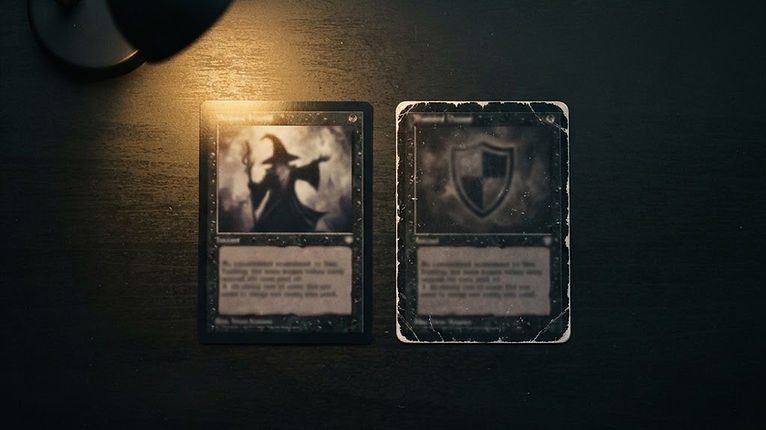
Near Mint and Lightly Played are the two condition labels you will see most often on raw Pokémon cards. They sound close, and on a quick glance the cards can look almost the same. But the gap between them changes what a card is worth, whether it makes sense to grade it, and how happy a buyer will be when the envelope arrives.
This guide explains what each label actually means, gives you a simple routine to check a card in about two minutes, and covers how to buy and sell honestly around the line between NM and LP.
Near Mint (NM) means the card looks essentially fresh from the pack to the naked eye. You may find one or two tiny flaws if you search closely, such as a speck of whitening on one back edge, but nothing jumps out.
Lightly Played (LP) means the card has small, visible wear that you notice without hunting for it. Think light whitening on several edges, a few minor surface scratches, or slightly soft corners. There are no creases, bends, or major damage.
A useful rule of thumb: if you have to tilt the card under a light to find the flaw, it is probably still NM. If you see the flaw at arm's length, it is probably LP.
Raw card conditions are not set by one official body. Marketplaces and stores each publish their own condition guides, and their wording differs slightly. Most use a ladder that looks something like this:
These labels are separate from professional grades. A PSA, CGC, or BGS number is assigned by a grading company after an expert inspection. NM and LP are judgments the seller makes. That is exactly why they cause disputes: two honest people can look at the same card and disagree. For the bigger picture of how raw labels relate to slab grades, see our trading card condition and grading guide.
Condition comes down to five parts of the card. Check them in this order and you will catch nearly everything.
Start here, because the back of most Pokémon cards has a dark blue border that shows white chips clearly.
NM: clean edges, or at most one or two tiny white specks.
LP: light whitening along several edges, or a short run of chipping on one edge.
Look at all four corners on the front and back.
NM: sharp corners. Maybe a tiny fleck of white on one corner.
LP: corners slightly rounded or with small white dots on more than one corner. No folded or peeling corners.
Hold the card under a single light source and tilt it slowly. Holo and full art cards show scratches much more easily than non-holo cards.
NM: no visible scratches at normal viewing, possibly a faint line only at a sharp angle.
LP: a few light scratches or scuffs you can see without tilting much, light print lines that are clearly wear, or small surface marks.
If you are not sure whether a line on a holo is a factory print line or a scratch, compare it with other copies of the same card. Print lines usually run straight across the whole card in one direction, while scratches tend to be short, uneven, and at random angles.
Lay the card flat on a table and look at it from the side, then run a light across it.
NM and LP: no creases and no bends.
Any crease, even a small one, usually pushes a card to Moderately Played or lower. A dent from a fingernail or a pressure mark can also drop it below LP, depending on how visible it is.
Centering is not wear, so many raw condition guides ignore it. But buyers care, especially anyone thinking about grading. A clean card with heavy off-centering can still be listed as NM, but it is fair to mention it in the listing. Our guide on how to check centering on Pokémon cards shows a quick way to measure it.
You do not need special tools. A desk lamp and a clean, dry surface are enough.
If you are photographing the card to sell it, use the same lamp setup. Our guide on how to photograph trading cards shows how to capture edges and surface so buyers can judge for themselves.
| Area | Near Mint | Lightly Played |
|---|---|---|
| Back edges | Clean or one or two tiny specks | Light whitening on several edges |
| Corners | Sharp | Slightly soft or lightly white |
| Surface | Clean at normal viewing | A few visible light scratches or scuffs |
| Bends and creases | None | None |
| First impression | Looks pack fresh | Looks well kept but handled |
For most bulk and common cards, the price gap between NM and LP is small. For chase cards, vintage holos, and anything a buyer might want to grade, it can be large. Buyers who plan to grade are paying for the chance of a high grade, and visible wear lowers that chance.
We are not going to quote a fixed percentage, because the gap changes by card, era, and demand. The reliable way to price it is to look at recent sold prices for the same card in the same condition, not just the NM number. Our guide on how much your Pokémon cards are worth walks through checking real sold data.
Condition also affects whether grading makes sense at all. A truly NM modern card might be worth sending to a grader. An LP card usually is not, unless it is a rare vintage card where even a mid grade has strong demand. See is it worth grading Pokémon cards and raw vs graded Pokémon cards before you decide.
Most cards drop from NM to LP through handling, not accidents. Sleeve valuable cards right after opening, keep them out of tight binder pockets, and store them away from heat and humidity. Our guide on how to store Pokémon cards covers the basics.
Is Near Mint the same as Mint? No. Mint suggests a card with no visible flaws at all, even under close inspection. Near Mint allows one or two tiny flaws. Many sellers avoid the word Mint for raw cards because almost every handled card has some small imperfection.
Can a Lightly Played card get a high grade? It is unlikely. Graders look closely at edges, corners, and surface, which are the same areas that make a card LP. An LP card more often lands in a mid range grade. If a card is worth grading mostly for authentication, such as some vintage cards, a mid grade can still make sense.
Does a card fresh from a pack count as Near Mint? Usually, but not always. Cards can come out of packs with factory whitening, print lines, or off-centering. Check every card the same way, even pack fresh ones.
Is Excellent the same as Lightly Played? Many sellers use Excellent as a similar label to Lightly Played, but definitions differ between stores and countries. Always read the description and look at the photos rather than relying on the word alone.
Should I list a card as NM if I am not sure? No. If you hesitate between NM and LP, list it as LP or describe it as NM to LP with clear photos of every flaw. Honest labeling builds repeat buyers.
PullBull is a marketplace for collectible trading cards built around auctions and collector stores. You can browse Pokémon cards by set and filter by condition and graded or raw, so you can compare listings with the condition you actually want.
Browse live auctions and listings on PullBull.
Browse Pokémon card auctions on PullBull